The 3rd UK-China Transition Finance Workstream Seminar Successfully Held in Shanghai

On 27 March, the third UK-China Transition Finance Workstream Seminar was successfully held in Shanghai. The seminar was co-hosted by HSBC, the Institute of Finance and Sustainability, the British Embassy Beijing, the City of London, and the China Climate Engagement Initiative, and focused on the theme of “Transition Finance and Transition Planning”. More than 100 representatives from government departments, financial institutions, key corporates, and research organisations in both China and the UK attended the seminar in person or online. The seminar reviewed the phased progress of the UK-China Transition Finance Workstream and featured exchanges on practices and insights from both countries in areas including the development and assessment of corporate transition plans, transition finance solutions for key sectors, the establishment of business systems within financial institutions, and the application of transition-related indices in capital markets. Participants also held in-depth discussions on the challenges and opportunities of transition finance, as well as priorities for deepening bilateral cooperation between China and the UK, further advancing mutual learning and practical collaboration in the field of transition finance.
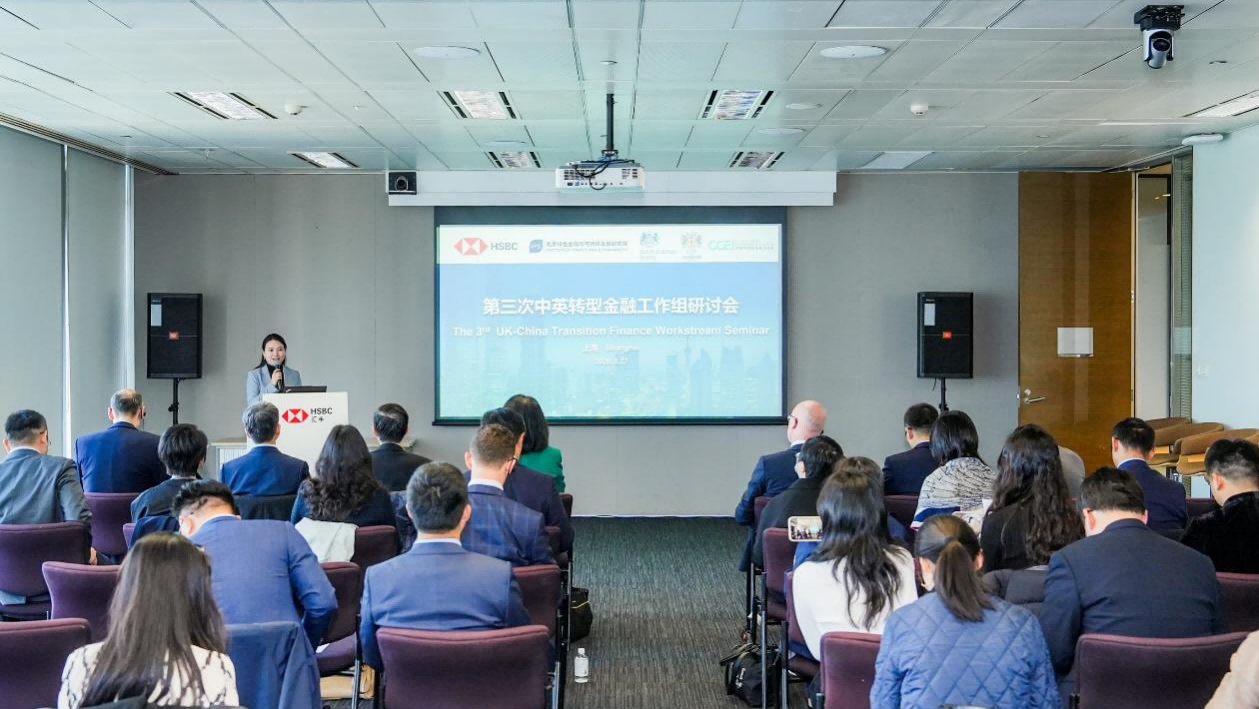
The UK-China Transition Finance Workstream was one of the important outcomes of the 11th UK-China Economic and Financial Dialogue in January 2025, and was formally launched during London Climate Action Week in June of the same year. Co-led by Bank of Communications and HSBC, with IFS serving as the secretariat, the Workstream aims to advance policy alignment, product innovation, and capacity building in transition finance between China and the UK, expand the scale of transition financing, and support the achievement of both countries’ climate goals.

In her opening remarks, Amy Wang, Executive Vice President, HSBC China, said that achieving climate goals requires not only the rapid growth of green industries, but also strong support for the transition of traditional high-emitting sectors. She noted that the core role of financial institutions lies in providing long-term and stable financing arrangements to support companies in advancing their transition along clear pathways. More specifically, she highlighted three key areas in which financial institutions can contribute: first, helping companies develop more transparent and credible transition plans; second, fostering financial solutions with both sustainability and scalability; and third, continuing to deepen international cooperation and the sharing of experience. Amy Wang also noted that supporting clients in their low-carbon transition is an important part of HSBC’s sustainability strategy. HSBC’s ambition is to become a net zero bank by 2050, and it aims to provide and facilitate between USD 750 billion and USD 1 trillion in sustainable finance and investment by 2030. By the end of 2025, the cumulative total had reached USD 495.6 billion, continuing to provide clients around the world with the financial support needed for transition.

In his opening remarks, Dr. MA Jun, Chairman of China Green Finance Committee, President of IFS, Co-chair of UK-China Green Finance Taskforce, reviewed the nearly decade-long development of UK-China cooperation in green finance. He noted that from the joint promotion of the G20 Green Finance Study Group by China and the UK in 2016, to the establishment of the UK-China Green Finance bilateral cooperation mechanism in 2017, and to the addition in recent years of two new workstreams on transition finance and natural capital, the two sides have consistently maintained a high level of cooperation in green and sustainable finance. Ma Jun pointed out that transition finance has enormous room for growth in the coming years. The transition finance framework developed by the G20 has been substantially adopted by the People’s Bank of China and has gradually evolved into China’s transition finance standards covering 11 sectors. Local authorities have actively carried out pilot practices in transition finance, and some regions have already developed replicable experience in areas such as transition taxonomies, carbon accounting tools, corporate planning templates, and policy support mechanisms, while transition lending has grown rapidly. However, to achieve truly scaled-up development, a number of practical challenges still need to be addressed, particularly in the preparation of transition plans, the reduction of carbon accounting costs, transaction structure design, and incentive mechanisms for corporate participation. He expressed his hope that these key issues could be discussed in depth during the seminar so as to jointly advance solutions for transition finance.

Michael Harvey, Counsellor of Financial and Professional Services at British Embassy Beijing, noted that, against the backdrop of mounting pressure around the global net-zero transition, transition finance is becoming a critical tool in addressing what many have called the “missing middle” of sustainable finance, helping carbon-intensive industries move from high to low emissions on the basis of transparent targets and verifiable outcomes. He pointed out that both the UK and China are at the forefront of recognising this imperative. The UK has been integrating transition planning into financial regulation in order to strengthen comparability and credibility across this emerging segment, while also reaffirming its ambition to be a leading centre for sustainable finance. China, meanwhile, has also been advancing rapidly by expanding its green bond market, developing transition finance taxonomy pilots, enhancing disclosure frameworks, and promoting innovation in hard-to-abate sectors. Over the past year, the UK-China Transition Finance Workstream has established an effective platform for policy alignment, deepening market-level dialogue, and strengthening two-way capacity building. Looking ahead, he suggested that both sides continue to focus on delivering meaningful and landmark market outcomes, including the issuance of a Chinese transition bond in London to help unlock international market potential. He also called for further progress in advancing capability building and strengthening alignment on transition standards and taxonomies, so as to better mobilise capital for an orderly and investable transition.
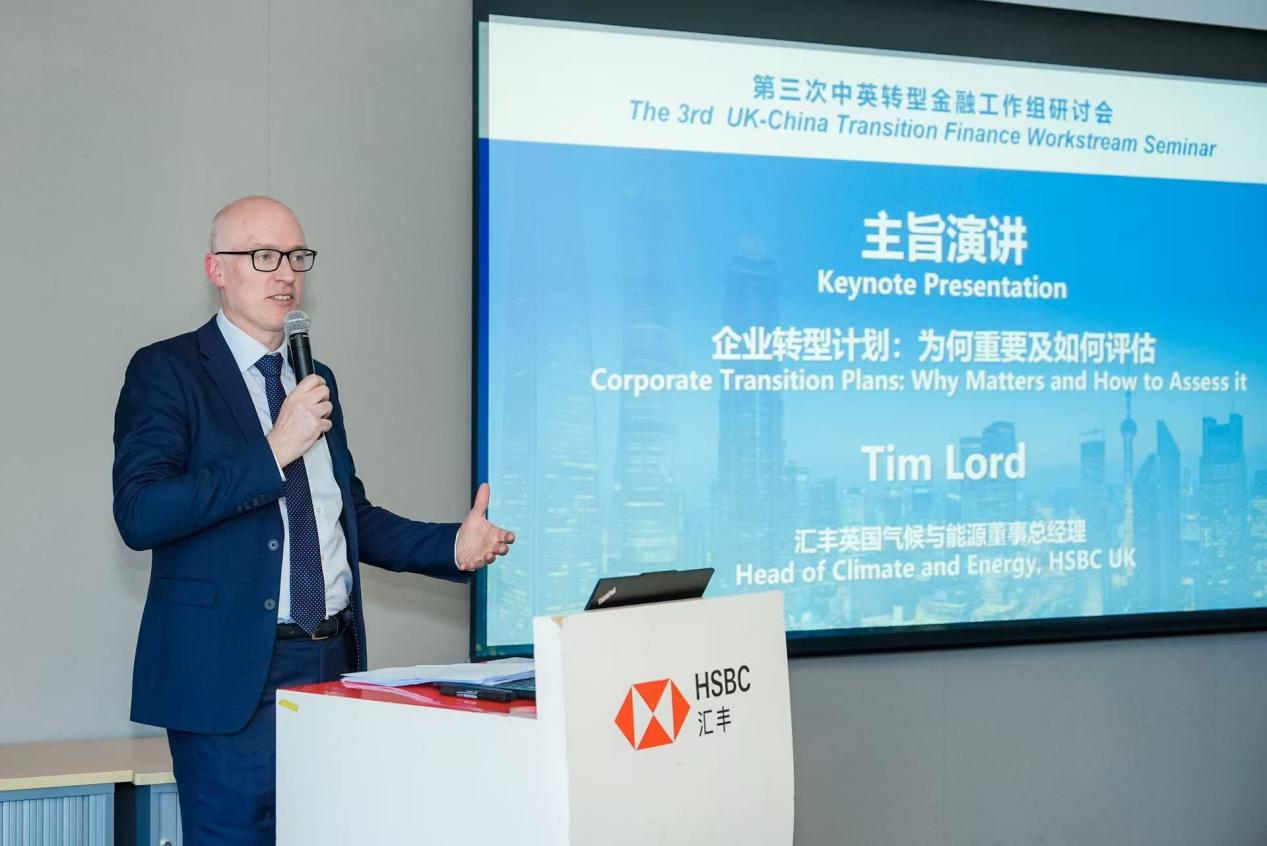
Tim Lord, Head of Climate and Energy, HSBC UK, delivered a presentation on “Corporate Transition Plans: Why They Matter and How to Assess Them”. He noted that as global emissions reduction enters a more complex and challenging phase, transition finance is becoming a key tool for bridging climate goals and economic realities. High-quality transition plans not only help enhance the clarity of corporate transition pathways, but also provide an important basis for financial institutions in making financing decisions and allocating resources. He introduced HSBC’s own transition plan, which has been published and is being continuously updated, and explained that the bank is constantly refining its work in three areas — client needs, identification of commercial opportunities, and organisational agility — in order to better support the differentiated transition needs of different regions and sectors.

FAN Shen, General Manager, Credit Management Department at Bank of Communications, delivered a keynote presentation on “Key Industries’ Transition Plan & Transition Finance Solutions.” He noted that the formulation and implementation of transition plans by enterprises in China’s high-emitting sectors have begun to take shape under a three-pronged framework of policy guidance, foundational support, and pilot practice. Continued policy requirements at the national and regulatory levels, the gradual improvement of carbon accounting systems and carbon markets, and the early demonstration pathways established by central state-owned enterprises, state-owned enterprises and industry leaders have all laid the groundwork for the development of corporate transition plans. However, taken as a whole, most enterprises, especially small and medium-sized enterprises, are still at an early stage and generally face practical obstacles, including a lack of willingness, lack of capability, poor planning quality, and difficulties in implementation and monitoring. Bank of Communications is supporting the transition of high-emitting sectors through an integrated four-part approach of standard-setting, transition advisory, positive incentives, and value-added services. This approach is intended to help enterprises formulate scientific and feasible transition plans while linking financing availability and financing costs to transition performance. Relevant practices have already expanded from shipping to multiple sectors, including steel, agriculture, building materials, and coal power, and have gradually formed transition finance pathways that are replicable and scalable. Looking ahead, he suggested further strengthening coordination among fiscal, monetary, and industrial policies, accelerating the issuance of guidelines for the preparation of corporate transition plans and the establishment of assessment and certification mechanisms, enhancing the professional support capacity of financial institutions in carbon accounting and transition planning, and providing enterprises with lower-cost and more sustainable transition financing through improved risk mitigation arrangements and stronger carbon data and disclosure infrastructure.

The subsequent Fireside Chat was moderated by Dr. MA Jun, Chairman of China Green Finance Committee, President of IFS, Co-chair of UK-China Green Finance Taskforce, and featured CHEN Yu, Deputy Director, Coordination Division, Office of the Financial Commission of the CPC Shanghai Municipal Committee, Tim Lord, Head of Climate and Energy, HSBC UK, and QIN Hua, Deputy General Manager, Credit Management Department, BoCom. The speakers engaged in in-depth discussions on how to address the challenges facing transition finance, advance its large-scale application, and promote practical cooperation between China and the UK under the current policy and market environment.

CHEN Yu, Deputy Director, Coordination Division, Office of the Financial Commission of the CPC Shanghai Municipal Committee, introduced Shanghai’s institutional exploration in transition finance from the perspective of local government. He noted that, supported by its strong industrial base and concentration of financial resources, Shanghai has a solid foundation for developing transition finance. At the institutional level, under the guidance of the People’s Bank of China, Shanghai took the lead in formulating local transition finance standards for six distinctive sectors, including steel and waterborne transport, overcoming challenges such as significant sectoral differences and difficulties in data coordination. The scale of transition loans has now exceeded RMB 10 billion, and some of these standards are being elevated to the national level. On the practical side, Shanghai has supported banks in expanding their client base and helped lower corporate costs by building a green finance service platform, project database, and industry-finance matchmaking mechanisms, alongside fiscal support policies introduced by different districts. In response to the difficulties banks face in client acquisition and the lack of motivation among some enterprises, the government is also exploring ways to strengthen coordination among government, banks and enterprises through curated recommendation lists and training programmes. Overall, he noted that against the backdrop of energy price volatility, enterprises’ demand and willingness for transition are rising rapidly, and the space for market-based transition finance services continues to expand.

During the fireside chat, Tim Lord, Head of Climate and Energy at HSBC UK, said that HSBC’s updated net-zero transition plan reflects the fact that the transition has entered a new phase — one that is both complex and uneven. He stressed that an effective transition plan cannot simply be owned by the sustainability team; it has to be owned by the business, including front-line bankers and risk teams, so that it genuinely reflects the realities of the business. In working with clients, HSBC has focused in particular on those with the largest emissions footprint and the greatest transition challenge. For some clients it has used “transition engagement questionnaires” to understand how the transition will affect their business, where they need to invest to decarbonise their operations and supply chains, and their exposure to physical and transition risks. This process can be used to help companies develop their own transition plans, with the approach being extended to smaller businesses in sectors with elevated transition risks. He noted that while transition planning should draw on shared models and frameworks, plans must ultimately be tailored to the individual business and, crucially, owned by that business itself. He also reaffirmed HSBC’s clear ambition for net zero by 2050, saying that the corporate sector and many governments remain absolutely committed to the transition for climate, energy security and cost reasons, and argued that greater investment in renewables is essential to strengthen energy resilience and autonomy.
.png "/uploads/image/2026/05/08/图片12(1).png")
Qin Hua, Deputy General Manager of the Credit Management Department of Bank of Communications, noted that three categories of policy are currently creating a “window of opportunity” for the development of transition finance. First, top-level policy has made transition finance move from being “optional” to becoming “essential”. Supporting policies now cover areas such as carbon market development, corporate carbon management, project-level carbon assessment, and product carbon footprints, providing commercial banks with a stable policy and market environment for further development. Second, transition finance standards have expanded from a small number of high-emitting sectors to 11 fields, including chemicals as well as copper and aluminium smelting, significantly broadening the target sectors and application scope of transition finance. Third, policy has clearly called for faster alignment with international standards, creating opportunities for domestic pilot projects to extend into international cooperation, including mutual recognition of standards, sector research, and the exploration of cross-border business opportunities. In identifying credible transition plans, Qin Hua emphasised the need to work on the basis of standards, deepen sector-specific research, and actively promote the integration of transition finance into the full credit process. Transition project databases established by local governments are, in practice, subject to screening and review, which helps enhance project credibility. He also pointed out that commercial banks still face a number of challenges in practice, including limited willingness among small and medium-sized enterprises to transition, mismatches between the supply of and demand for transition finance, the complexity of transition planning pathways, and difficulties for banks in assessing transition risks. Looking ahead, he expressed the hope that the UK-China Transition Finance Workstream would further expand practical business cooperation and explore international collaboration opportunities.

During the Output Release and Presentation session, ZHAO Lijian, Director of the Greentech Innovation and Investment Center, IFS, presented the 2025 UK-China Transition Finance Workstream Progress Report. He noted that since the launch of the Workstream, it has brought together 29 member institutions, held three bilateral seminars, established a multi-dimensional communication mechanism, set up four sub-working groups, and supported policy dialogue and mutual learning on standards. The report points out that transition finance still faces five major challenges: fragmented standards systems, lagging capacity building, insufficient corporate motivation, inadequate policy coordination, and insufficient market development. In response, it proposes recommendations in five areas: mutual recognition of standards, incentive and safeguard mechanisms, joint capacity building, policy coordination, and co-creation of financial products. The report also includes more than 30 transition finance case studies from both China and the UK, showcasing a wide range of practical achievements in areas such as standards and incentive frameworks, business innovation in key sectors including transport, industry, agriculture and buildings, the development of institutional systems within financial institutions, and research outcomes.

CHEN Huimeng, Deputy General Manager of the Credit Management Department, Postal Savings Bank of China, shared research findings on “Finance: Frameworks, Mechanisms, and Practical Exploration.” As the lead institution of the sub-working group on financial institutions’ business systems and mechanism development, Postal Savings Bank of China, together with SPD Bank, Bank of Huzhou, and Guotai Junan Securities (UK), conducted joint research and produced phased research outcomes. She noted that the development of transition finance is of great significance for advancing the “dual carbon” goals, optimizing credit structure, and supporting the orderly transformation and upgrading of traditional high-emitting industries. She pointed out that transition finance currently faces five common challenges: gaps in awareness and capability, including a shortage of interdisciplinary talent and insufficient internal coordination; an incomplete transition standards system, with differences in recognition standards across regions and institutions; lagging risk assessment tools that make it difficult to professionally price climate and policy risks; insufficient cooperation from enterprises, many of which lack comprehensive transition plans and standardized disclosure; and inadequate external incentive and constraint mechanisms, as well as insufficient supporting infrastructure. In response to these challenges, the report proposes six directions for building a systematic business mechanism: improving governance structures by establishing a three-tier coordination framework; strengthening top-level design by formulating financial institutions’ own transition plans and conducting carbon accounting; optimizing policies and systems by integrating transition finance into the entire credit management process; improving incentive and accountability mechanisms by incorporating transition finance into performance evaluation and linking it to resource allocation; enhancing product innovation by building a product matrix covering credit, bonds, carbon finance and other instruments; and applying financial technology to build digital platforms for dynamic monitoring and risk early warning. Finally, the report recommends that government departments improve unified standards and infrastructure, enterprises take the initiative in developing science-based transition plans, and professional institutions strengthen carbon accounting and third-party verification capabilities, so that all parties can work together to build a transition finance ecosystem.
.png "/uploads/image/2026/05/08/图片15(1).png")
David Harris, LSEG Head of Sustainable Finance Strategic Initiatives and Partnerships, gave a thematic presentation on the application of transition finance in stock indices. He focused on how LSEG has applied a transition finance classification system to index design. Originating from the Transition Finance Market Review, the system covers three categories of activity: climate solutions, aligned and aligning activities, and the retirement of higher-emitting assets. It can be assessed through two lenses — at the activity level and at the entity level. LSEG has applied this framework in its FTSE Russell climate indices by varying company weights, rather than relying solely on standard market-capitalisation weighting, through a transparent, rules-based methodology built on a range of climate factors. These include the Transition Pathway Initiative’s management quality and carbon performance assessments, FTSE Russell’s green revenue classification system, and carbon reserves exposure, thereby providing pension funds and other investors with a scalable passive investment tool. The indices have already seen adoption at scale by a range of institutional investors, meaning that companies are increasingly being upweighted or downweighted based on the quality of their climate transition plans. Looking ahead, Harris said LSEG will work together with UK and Chinese partners on two research papers under the UK-China Transition Finance. The first will focus on assessing the quality of corporate transition plans, including in light of ISSB rollout and the quality of corporate reporting in the UK and China. The second will examine taxonomy issues, particularly in the more difficult or hard-to-abate sectors. He noted that the aim is to launch these papers during London Climate Action Week and to connect them with the UK-China Economic and Financial Dialogue shortly afterwards.

During the panel discussion, ZHANG Huifeng, Head of Sustainability Strategy, Philanthropy and Partnerships, Asia and Middle East, HSBC, served as moderator and led an in-depth panel discussion on the theme of “Corporate Transition Plans and the Application of Transition Finance” with Hong ZHANG, Vice-Chair of Executive Committee at British Chamber of Commerce in China and VP of Shell China, Victoria ZAN, Director of Transition Finance & Advisory at Standard Chartered, ZHANG Wangyan, Deputy General Manager of the Corporate Banking Department at Bank of Nanjing, and Dr Jim Liu, Senior Investment Officer, Financial Institutions and Funds Clients, AIIB.

Hong ZHANG, Vice-Chair of Executive Committee at British Chamber of Commerce in China and VP of Shell China, noted from a corporate perspective that when setting transition targets and plans, companies need to balance the expectations of shareholders, regulators, clients and the market. She observed that the ambitious transition targets put forward by multinational energy companies at an early stage were a response to social expectations and market pressure, but that under real-world constraints such as geopolitical tensions and energy price volatility, companies need to adjust their pathways dynamically in line with industrial structure, product mix and society’s capacity to absorb change, so as to remain aligned with the broader pace of social transition. She said that by participating in this seminar organised by the financial sector, she had gained a better understanding of the extensive exploration undertaken by financial institutions in the design of transition-related tools, products and frameworks, which could help break down information barriers between corporates and financial institutions. Taking transitional solutions such as LNG as an example, she pointed out that companies, financial institutions and standard-setters may differ in their understanding of what constitutes a “transition activity”. Looking ahead, she said that continued dialogue, the implementation of flagship projects and innovation in financing structures will be needed to explore viable pathways between real-world industrial constraints and long-term climate goals.
.png "/uploads/image/2026/05/08/图片19(1).png")
Victoria ZAN, Director of Transition Finance & Advisory at Standard Chartered, stressed from the perspective of an international bank that the key to transition finance is not simply to “label” companies, but to provide more targeted financing and advisory support based on the stage of transition that different sectors, regions and clients are in. She argued that the most important thing between financial institutions and corporates is to establish a higher-quality two-way communication mechanism, so that financial institutions can better understand companies’ practical difficulties, investment timelines and capital needs, while companies can also better understand the constraints faced by financial institutions in relation to risk management, disclosure requirements and internal standards. Drawing on Standard Chartered’s business practice, she noted that during the transition process, companies may generate both long-term financing needs related to technology upgrades and production line transformation, as well as working capital needs associated with supply chain adjustments and raw material procurement. Banks therefore need to provide more tailored support solutions, including project finance and trade finance. She also emphasised that a transition finance framework is not closed or static, but should be continuously refined and improved through ongoing client dialogue and practical project experience. Only in this way, she said, can transition finance products move beyond merely “looking reasonable” in principle and become solutions that companies are genuinely willing to use and that can support real-world transition.
.png "/uploads/image/2026/05/08/图片20(1).png")
ZHANG Wangyan, Deputy General Manager of the Corporate Banking Department at Bank of Nanjing, shared the experience of a regional Chinese bank in supporting transition. She noted that, on the one hand, companies and banks need to move towards each other in a genuinely mutual way: companies’ own transition efforts help drive banks towards their transition goals, while banks also need to provide stronger support in terms of financing availability, financing costs and related services. On the other hand, banks must also develop the ability to identify, assess and support transition plans for different types of enterprise. Nanjing Bank has incorporated transition finance into its core strategy and green finance development plan, and has improved its institutional arrangements in areas including the identification of transition entities, risk assessment, credit standards, product and service design, and internal incentives. It has also used digital tools to improve the efficiency of transition plan preparation, review and performance tracking. For many small and medium-sized enterprises, a single financing instrument is often insufficient to solve the problem. Banks therefore need to build a systematic service framework and provide long-term support to clients through a combination of financial and non-financial services, thereby continuing to facilitate companies’ low-carbon transition. She also noted that advancing transition finance is a systemic undertaking that requires the joint participation of decision-makers, transition actors, financial institutions and the wider public in order to build collective momentum for its development.
.png "/uploads/image/2026/05/08/图片21(1).png")
Dr. Jim Liu, Senior Investment Officer at the Financial Institutions and Funds Clients Department of the Asian Infrastructure Investment Bank (AIIB), attended the panel. From the perspective of a multilateral development financial institution, he shared experience and insights on transition finance, introduced relevant financial products and instruments of the AIIB, and expressed expectations for strengthened cooperation and collaborative innovation with commercial banks to jointly support transition financing projects.
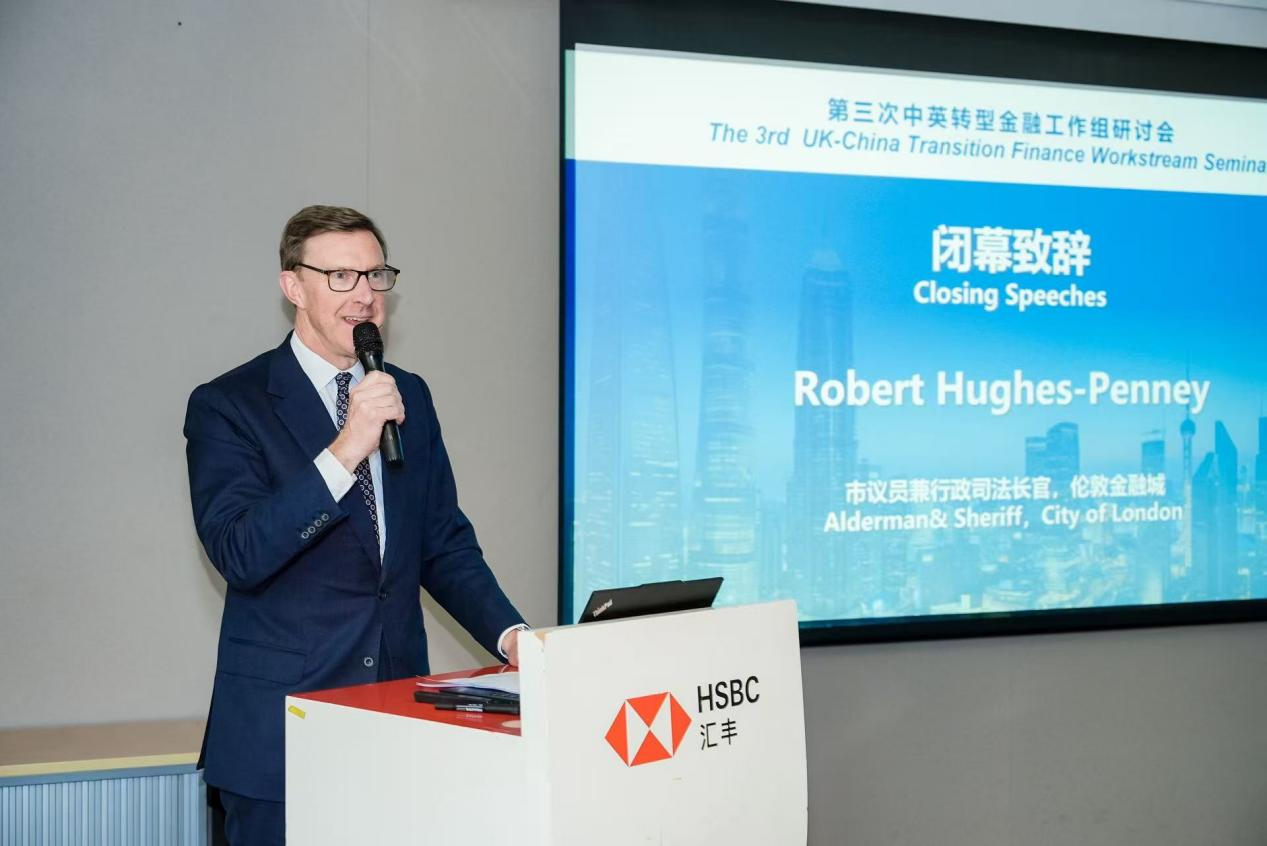
In the closing remarks, Robert Hughes-Penney, Alderman and Sheriff of the City of London, said that green finance is one of the most important areas of cooperation in which he has long been closely involved, and that the City of London has consistently regarded advancing UK-China cooperation in green finance as a key priority. He noted that London is a “one-stop shop” for green finance, offering a full spectrum of green finance products and services to support global net zero and biodiversity goals, and has become a hub for cross-border green finance listings and international capital flows into sustainable projects. Robert Hughes-Penney said that, through the joint efforts of the City of London, the Institute of Finance and Sustainability, and the UK-China Transition Finance Workstream, exchanges and cooperation in transition finance have already delivered strong results. Looking ahead, he encouraged more institutions to engage with the workstream, welcomed Chinese partners to join events during London Climate Action Week in June, and expressed the hope that Shanghai and London, as well as the UK and China, would deepen cooperation in green finance and work together to achieve shared climate goals.
In February 2025, the Transition Finance Council, co-launched by the City of London Corporation and HM Government, published an exposure draft of its Transition Finance Guidelines. The Guidelines help capital providers assess the credibility of a company’s transition planning and implementation, with a focus on real economy companies, particularly in high-emitting sectors.
Link: Transition Finance guidelines

In his closing remarks, MA Jun, Chairman of China Green Finance Committee, President of IFS, Co-chair of UK-China Green Finance Taskforce, said that today’s discussion once again showed that transition finance has entered a new stage in which specific questions must be answered and practical barriers must be addressed. He responded in particular to the real-world challenges raised by Fan Shen, General Manager of the Credit Management Department of Bank of Communications, in his keynote speech, including the fact that many companies are unwilling to act, do not know how to act, struggle to produce high-quality plans, and face difficulties in implementation and monitoring. Ma Jun then put forward a number of concrete suggestions for action. He stressed that the next phase of work must not remain at the level of broad principles, but should focus on deepening research and cooperation in areas such as guidance for the preparation of transition plans, assessment and certification mechanisms, low-cost carbon accounting, capacity building for financial institutions, improved product suitability, and the design of incentive mechanisms. He noted that China and the UK have broad scope for cooperation on these issues, and expressed the hope that the Workstream would deliver more outcomes in practical implementation and cross-border cooperation, so as to better support low-carbon transition efforts in both countries and globally.
The seminar was moderated by Jeanie YANG, Senior Researcher, Greentech Innovation and Investment Center at IFS.